What Is a Street-Legal LSV Golf Cart? Everything You Need to Know
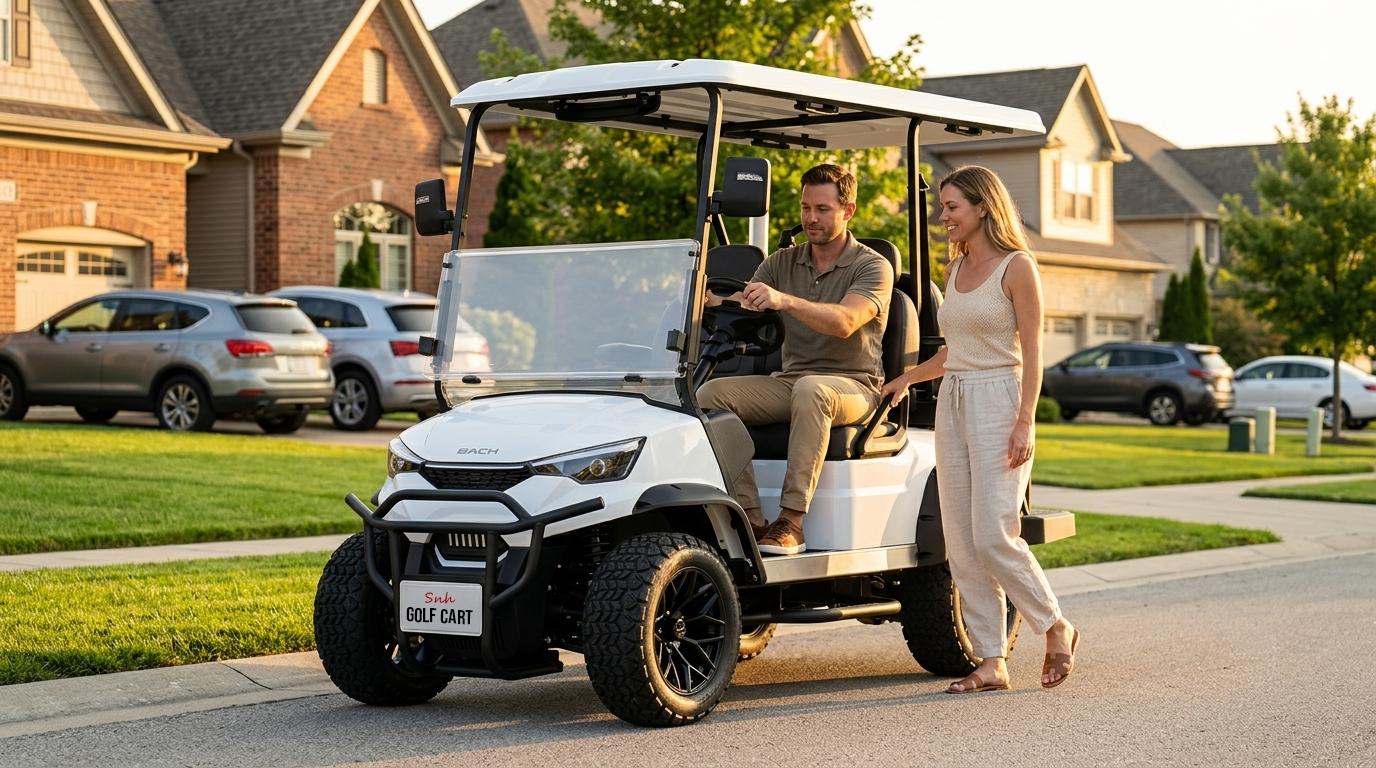
You've probably seen them out there: golf carts gliding down a quiet neighborhood street, stopping at intersections, turning signals blinking. And your first thought was likely some version of, "Wait, is that actually legal?"
The short answer is yes, but only under a specific set of conditions that most people don't fully understand when they start shopping. A street legal golf cart isn't just any cart taken out for a spin on a public road.
It's a federally recognized vehicle category with its own safety standards, registration requirements, and road rules. And knowing the difference between a standard cart and a true LSV golf cart matters a lot before you spend money on the wrong thing.
This guide covers what a low speed vehicle (LSV) actually is, what makes a cart street legal, how the requirements work in New Hampshire specifically, and what your options are if you want to get on the road legally.
The Market Is Growing for a Reason
Before getting into the technical side, it's worth understanding why this question is coming up more often.
The global low speed vehicle market was valued at $11.9 billion in 2025 and is projected to reach $19.17 billion by 2035, growing at a compound annual growth rate of 5.5%. Golf carts represent the largest vehicle type in that market, holding a major share of the total segment. This isn't a niche category anymore.
Industry data shows that a vast majority of neighborhood electric vehicle owners use their LSV daily for short trips, and almost half of them frequently travel distances between two and five miles. These are practical daily transportation numbers, not recreational weekend stats.
What Is a Low Speed Vehicle?
A low speed vehicle, or LSV, is a federally recognized motor vehicle category defined by the National Highway Traffic Safety Administration (NHTSA) under Federal Motor Vehicle Safety Standard 500, commonly referred to as FMVSS 500.
The legal definition is straightforward: a four-wheeled motor vehicle with a top speed greater than 20 mph but not greater than 25 mph. That speed window is what sets an LSV apart from both a standard golf cart (which typically tops out at 12 to 15 mph) and a full motor vehicle (which is built for highway speeds). An LSV exists specifically in the 20 to 25 mph lane, and that specific range is what makes it eligible for registration and road use.
In New Hampshire, the state uses the term Neighborhood Electric Vehicle, or NEV, to describe this same category. The NH DMV defines a NEV as a four-wheeled electrically powered vehicle with a speed higher than 20 mph and less than 25 mph. For practical purposes, LSV and NEV refer to the same vehicle type in this state.
The distinction matters because a standard golf cart, no matter how new or well-equipped it looks, is not a street legal golf cart under New Hampshire law unless it meets the NEV definition. Speed alone does not make a cart legal. Equipment, registration, and classification all have to align.
What Makes a Golf Cart Street Legal?
This is the question most buyers are really asking when they start researching LSV golf carts. The answer comes down to two things working together: equipment and registration.
The Federal Equipment Requirements
To qualify as a low speed vehicle under FMVSS 500 and be eligible for road use, a cart must carry a full set of safety equipment. Here's the complete list:
Required Feature | Specification |
Headlights | DOT-approved, functional for nighttime use |
Taillights and brake lights | Activate when braking, rear-facing |
Turn signals | Front and rear on both sides |
Reflectors | Amber front, red rear |
Windshield | Full windshield required |
Mirrors | Driver-side exterior mirror at minimum |
Seat belts | Required at every seating position |
Vehicle Identification Number | 17-digit VIN required |
Top speed | Must reach between 20 and 25 mph |
Power source | Electric only for NH NEV classification |
None of these are optional upgrades. Every item on this list is a compliance requirement. A cart that's missing even one of them cannot be registered as a NEV in New Hampshire and cannot legally operate on a public road, regardless of how it's marketed or how it looks.
The Registration Side
Equipment alone isn't enough. A street legal golf cart must be registered as a motor vehicle with the NH DMV. That process requires:
- The Manufacturer's Certificate of Origin or existing title
- Proof of purchase (bill of sale)
- A valid driver's license for the operator (minimum age 16, no special permit)
- Liability insurance, required for registration the same as any motor vehicle
Once registered, the cart is treated the same as any other motor vehicle for the purposes of DUI enforcement, traffic laws, and insurance requirements. There is no recreational exemption for registered NEVs on public roads in New Hampshire.
For the full breakdown of the registration process and road rules that apply after registration, the Hampshire Golf Cart Laws 2026 guide covers everything in one place.
Where Can You Drive a Street Legal Golf Cart in New Hampshire?
Once registered as an NEV, a street legal golf cart can be driven on any state road with a posted speed limit of 35 mph or lower. It can also cross roads with higher posted speed limits at intersections, which opens up practical routes across most of southern New Hampshire without requiring the cart to travel on high-speed roads.
For buyers in Londonderry, Manchester, Nashua, and surrounding communities, this translates to genuine daily usability. Most residential neighborhood roads, local commercial areas, and community routes fall within the 35 mph threshold. Crossing a 45 mph road to get to the next neighborhood street is fully permitted.
Some municipalities may have additional local rules for specific areas, so it's always worth a quick check with your town if you're planning regular routes through a downtown corridor or near a school zone. But the statewide framework gives NEV owners broad access across the region.
How Does a Street Legal Golf Cart Differ From a Standard Cart?
The differences go well beyond a sticker or a registration plate. A standard golf cart and a street legal LSV are genuinely different vehicles in terms of engineering, safety, and legal standing.
A standard golf cart is designed for private property and controlled environments. It has no federal safety requirements, no VIN, no required lighting or seat belts, and no registration. It cannot legally operate on a public road in New Hampshire under any circumstances.
The moment a standard cart enters a public street, it's operating as an unregistered motor vehicle, which carries fines and, more importantly, means the operator has no insurance coverage in the event of an accident.
An LSV golf cart is built to road-use standards from the ground up. The lighting is DOT-approved. The seat belts meet federal specifications. The speed range is engineered for legal compliance, not just performance. And the presence of a factory-assigned VIN means the registration process starts from a clean, documented baseline.
The practical implication for buyers is that these two categories are not interchangeable. If you intend to drive on public roads, you are not shopping for a standard cart. You are shopping for a vehicle that was built or converted to meet every item on the FMVSS 500 compliance list.
How to Make a Golf Cart Street Legal: New vs. Converted
If you already own a standard cart and want to understand how to make a golf cart street legal, the path is possible but worth evaluating honestly.
Conversion involves sourcing and installing every required safety component, including DOT-approved lights, front and rear turn signals, a full windshield, mirrors, seat belts at every position, and reflectors.
If the cart doesn't already have a 17-digit VIN, one must be assigned before registration is possible. The cart must then be inspected to confirm it can reach and maintain the required 20 to 25 mph speed range.
The cost and complexity of conversion vary significantly depending on the starting condition of the cart. An older lead-acid cart that was never designed for road use may require extensive electrical work, structural modifications, and component sourcing that adds up quickly. A more recent cart with better baseline specs is a more practical conversion candidate.
For most buyers, purchasing street legal golf carts for sale that were factory-built to LSV specification is the faster, cleaner, and more reliable route. Modern Golf Carts built to NEV standards arrive with every required feature already installed, a VIN already assigned, and documentation ready for the NH DMV process. The compliance work is done before the cart reaches the buyer.
Premium Golf Carts configured as factory LSVs are available across 4-seat and 6-seat configurations for buyers looking to start from full compliance rather than work toward it.
Is a Street Legal Golf Cart Worth It?
For buyers who plan to use the cart on private property only, a standard cart is a practical, lower-cost choice. The LSV compliance package adds real expense, and if you never touch a public road, that expense doesn't unlock anything for you.
For buyers who want to drive through their neighborhood, cross public roads, run local errands, or use the cart as genuine daily transportation, the answer is different. A cart that isn't registered as an NEV has no business on a public road regardless of how it's equipped, and operating one on public roads without registration creates real financial and legal exposure.
The Are Golf Carts Street Legal in New Hampshire guide breaks down the full picture of what qualifies and what doesn't, including the registration process step by step.
The investment in a street legal cart is not a luxury premium for most daily-use buyers. It's the cost of legal road access across all of southern New Hampshire.
Ready to Get on the Road?
If you know what you're looking for and want to see what's available, SNH Golf Carts carries factory-compliant LSV golf carts built to New Hampshire's NEV specification, with registration guidance included as part of the buying process.
FAQs
Q1. Are golf carts street legal in New Hampshire without modifications?
A standard unmodified golf cart is not street legal in New Hampshire. To operate on public roads, a cart must meet the state's NEV definition, which requires a top speed between 20 and 25 mph, full FMVSS 500 safety equipment including seat belts, lights, and turn signals, a 17-digit VIN, and registration as a motor vehicle with the NH DMV. Factory-built LSV configurations come with all of this already in place.
Q2. What is the difference between an LSV and a NEV in New Hampshire?
In practice, they refer to the same vehicle category. The federal government uses the term Low Speed Vehicle, or LSV. New Hampshire uses the term Neighborhood Electric Vehicle, or NEV, in its motor vehicle code. Both describe a four-wheeled electric vehicle capable of 20 to 25 mph that meets FMVSS 500 standards and is registered for public road use. The terminology differs but the legal and equipment requirements are identical.
Q3. Can I drive a street legal golf cart on any road in New Hampshire?
Registered NEVs can be driven on any state road with a posted speed limit of 35 mph or lower, and can cross roads with higher speed limits at intersections. They cannot travel along roads with speed limits above 35 mph. Some municipalities may have additional local restrictions in specific zones, so checking with your local town for routes through downtown areas or school zones is always a practical step.
Q4. Do I need insurance for a street legal golf cart in New Hampshire?
Yes. Liability insurance is required to register an LSV in New Hampshire, exactly the same as any registered motor vehicle. Annual premiums for NEVs typically run $100 to $300, which is considerably less than standard passenger vehicle coverage. Operating a registered NEV without insurance carries the same legal consequences as driving any uninsured motor vehicle in the state.