New Hampshire Golf Cart Laws 2026: Street Legal Rules, Requirements and Where You Can Drive
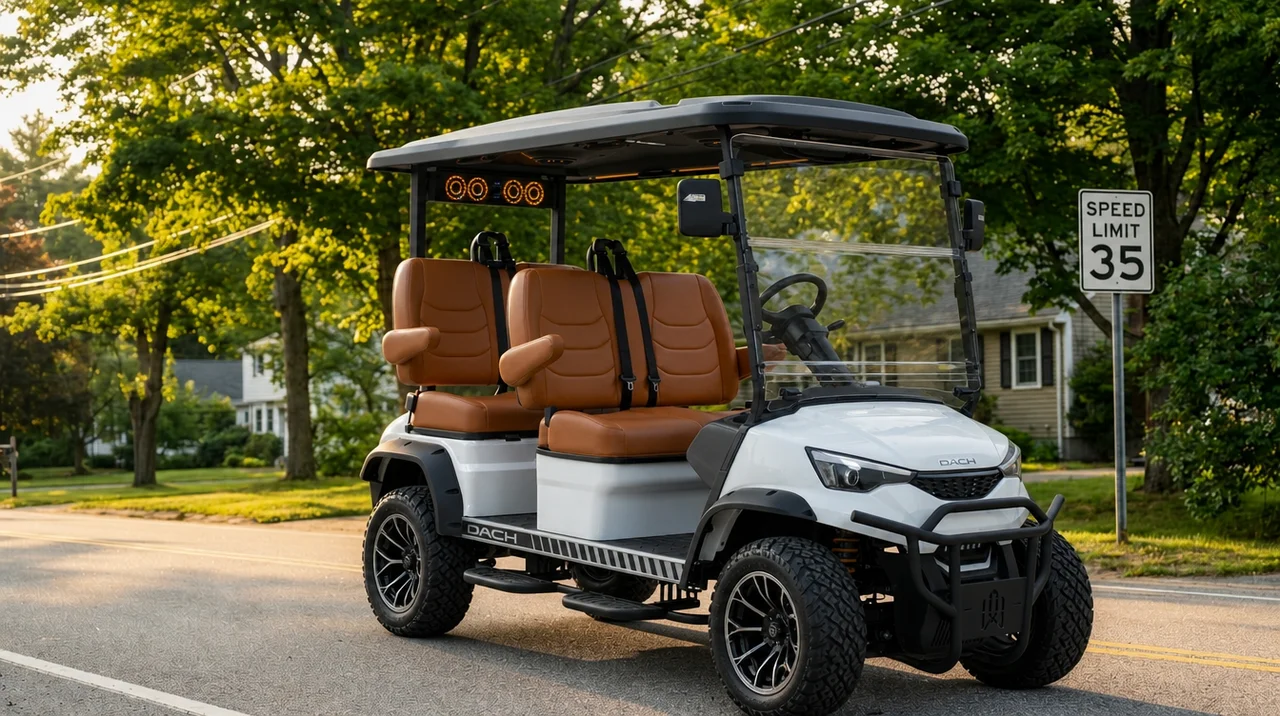
You've spotted them on quiet neighborhood roads in Londonderry. You've seen them cutting through Manchester side streets and humming along Nashua's residential blocks. Golf carts are showing up on New Hampshire roads more and more, and if you're wondering whether that's actually legal, and whether you could do it too, you're asking exactly the right question.
The truth is, it depends entirely on the cart and how it's set up. Not every golf cart qualifies for road use in New Hampshire, and the rules are specific enough that getting it wrong means fines, failed registration, or worse. This guide covers everything you need to know about golf cart laws in NH for 2026, written in plain language so you can figure out where you stand before you ever turn a key.
Why This Matters More in 2026 Than Ever Before
Golf carts are no longer just for courses. Electric golf carts captured 81.81% of the market share in 2025 and are projected to reach 85% in 2026, as rising fuel prices and emission regulations push buyers toward zero-emission models. That shift is real and it's playing out right here in New England.
The US electric golf cart market is projected to grow from $529.4 million in 2024 to $886.7 million by 2033, driven largely by rising adoption in gated communities, resorts, and government fleets. And as more people buy electric carts for everyday use rather than just recreational riding, the question of what's road legal becomes a practical one, not just a theoretical one.
The Core Distinction: Golf Cart vs. Neighborhood Electric Vehicle
This is the single most important thing to understand about golf cart laws in New Hampshire, and it's where most people get confused.
The state of New Hampshire does not define a golf cart in its motor vehicle code. A Neighborhood Electric Vehicle (NEV) is essentially a golf cart that has been modified so that it can travel at a higher speed. New Hampshire DMV identifies a NEV as a four-wheeled electrically powered vehicle with a speed higher than 20mph and less than 25mph.
In practical terms, this means two things. First, a standard golf cart, the kind used on a golf course that tops out around 12-15mph, is not street legal in New Hampshire. Second, a cart that's been built or upgraded to meet the NEV definition is treated as a registered motor vehicle and is permitted on certain public roads.
The term "street legal golf cart" in NH always refers to a vehicle that meets the NEV classification. If your cart doesn't hit 20mph and carry the required safety equipment, it doesn't qualify regardless of how new or nice it is.
What Your Cart Needs to Be Golf Cart Road Legal in NH
To be registered and driven on public roads in New Hampshire, a cart must meet federal LSV safety standard 49 CFR 571.500. It must have headlights, turn signals, tail and brake lights, reflectors, a windshield, mirrors, seat belts, and a 17-digit VIN. It must also be electric and capable of speeds between 20 and 25mph.
Here is the full equipment checklist in one place:
Required Feature | Specification |
Headlights | DOT-approved, functional at night |
Taillights and brake lights | Activate when braking |
Turn signals | Front and rear, both sides |
Reflectors | Amber front, red rear |
Windshield | Full windshield required |
Mirrors | Driver's side exterior mirror minimum; both sides recommended |
Seat belts | Required at every seating position |
VIN | 17-digit vehicle identification number |
Top speed | Between 20mph and 25mph |
Power source | Electric only for NEV classification in NH |
If you're buying a factory-built LSV golf cart that already comes VIN-assigned and fully equipped, the compliance work is done before the cart arrives. If you're starting with an older cart and converting it, every item on this list needs to be addressed before you can register it.
Where You Can Actually Drive a Street Legal Golf Cart in NH
New Hampshire golf cart laws state that a Neighborhood Electric Vehicle can be driven on state roads with a posted speed limit of 35mph or lower. They can also cross roads with a speed limit higher than 35mph at intersections.
That crossing provision matters more than it might seem. It means you're not locked into a single zone. You can legally cross a 45mph road to reach the next 35mph street, which opens up real practical routes for getting around your community without a car.
New Hampshire law allows NEVs statewide on roads with posted speed limits of 35mph or lower, so specific city ordinances are generally not required. However, individual localities may petition to restrict NEV use for safety reasons, and some towns have enacted local rules for golf carts on town property or in private communities.
For buyers in Londonderry, Manchester, Nashua, and surrounding communities, the state rules apply uniformly. But it's always worth a quick check with your local town hall if you're planning specific regular routes, particularly through downtown areas or near school zones.
Registration, Licensing, and Insurance: The Paperwork Side
Getting your golf cart legal in New Hampshire is not just about equipment. The administrative side is equally important and just as enforceable.
- Registration: Must be registered as a motor vehicle with the NH DMV. You'll need the Manufacturer's Certificate of Origin and your bill of sale at the time of registration.
- Driver's license: A valid NH driver's license is required and the minimum age is 16. There is no special golf cart permit; the standard licensing requirement applies to any operator on public roads.
- Insurance: Liability insurance is required for registration, the same as any registered motor vehicle in the state.
It is illegal to drive a NEV while under the influence of alcohol or drugs in New Hampshire. If the driver is found to be intoxicated, they will receive a citation in accordance with state law. DUI laws apply to NEV operation exactly as they do to passenger vehicles. There is no recreational exemption.
One practical note on registration: electric powered golf carts must meet all required provisions to be eligible for registration. Once registered, they can be driven on roads with a posted speed limit of 35 miles per hour or less. The registration process itself is handled through your county DMV office, and most dealers familiar with the NH market can help you prepare the paperwork at the point of sale.
Low-Speed Utility Vehicles: A Separate but Related Category
Most people shopping for a street legal golf cart are thinking about NEVs, but NH law also recognizes a second category worth knowing about: Low-Speed Utility Vehicles.
Low-Speed Utility Vehicles, which can be gas or diesel and often include small utility carts, are also allowed on roads up to 35mph in New Hampshire but cannot travel more than 25 miles from the owner's residence or business.
This category is relevant for facility managers, farm operators, and commercial property owners who may be using utility-style carts for work purposes rather than personal transportation. The 25-mile radius rule is a meaningful limitation for commercial applications, so it's worth factoring into the decision when choosing between a utility vehicle and a fully registered NEV.
Buying New vs. Converting: Which Route Makes More Sense?
If you already own a non-compliant cart and want to make it road legal, conversion is possible. It involves sourcing every required component, getting a VIN assigned if one isn't already present, and completing the NH DMV registration process with all documentation. For older carts in good mechanical condition, this can be a cost-effective path.
For most buyers though, purchasing a cart that's already factory-built to LSV specification is the faster and more straightforward route. Modern electric carts built to NEV standards come with every required feature pre-installed and a VIN already assigned. SNH Golf Carts, based in Londonderry, works with buyers throughout southern New Hampshire to identify which vehicles qualify as NEVs under state law and handles the registration guidance as part of the purchase process.
The honest answer to "should I convert or buy new" depends on the condition and age of your current cart, the cost of the required components, and whether you want the reliability of factory compliance or are comfortable managing the conversion process yourself. Either way, the legal destination is the same; a fully equipped, registered, insured vehicle that meets NH's NEV definition.
Ready to Get on the Road Legally?
Understanding the golf cart laws in New Hampshire is the first step. The second is finding a cart that meets every requirement right out of the box. SNH Golf Carts carries factory-compliant electric golf carts built to NH's NEV specification, and the team is available to walk you through registration, insurance guidance, and everything else before you take delivery.
Browse Street Legal Golf Carts
FAQs
Q.1 Can I drive any golf cart on NH roads if I stay under 35mph? No. Speed alone does not make a golf cart legal in New Hampshire. The vehicle must be classified as a Neighborhood Electric Vehicle, which requires a specific speed range of 20-25mph, a full suite of safety equipment, electric power, a 17-digit VIN, and registration with the NH DMV as a motor vehicle.
Q.2 Do golf cart rules in NH require insurance? Yes. If the vehicle is registered as an NEV/LSV in New Hampshire, it must follow normal vehicle insurance requirements and liability insurance is required for registration. This is the same standard applied to any registered motor vehicle in the state. There is no reduced requirement for low-speed vehicles.
Q.3 Can a 15-year-old drive a street legal golf cart in NH? Not on public roads. New Hampshire law requires an operator to be at least 16 and hold a valid driver's license to legally drive an NEV on a public road. There is no special golf cart permit the standard licensing requirement applies. On private property like a golf course or gated community, the property owner sets their own age rules.
Q.4 What happens if I drive an unregistered golf cart on a public road in NH? It is treated as operating an unregistered motor vehicle, which carries fines under NH motor vehicle law. Beyond the financial penalty, an unregistered cart also means no insurance coverage, which creates significant liability exposure in the event of an accident. The enforcement climate nationally has tightened considerably, with tens of thousands of citations issued in 2025 alone.