Golf Cart vs LSV in New Hampshire: Which One Is Right for You?
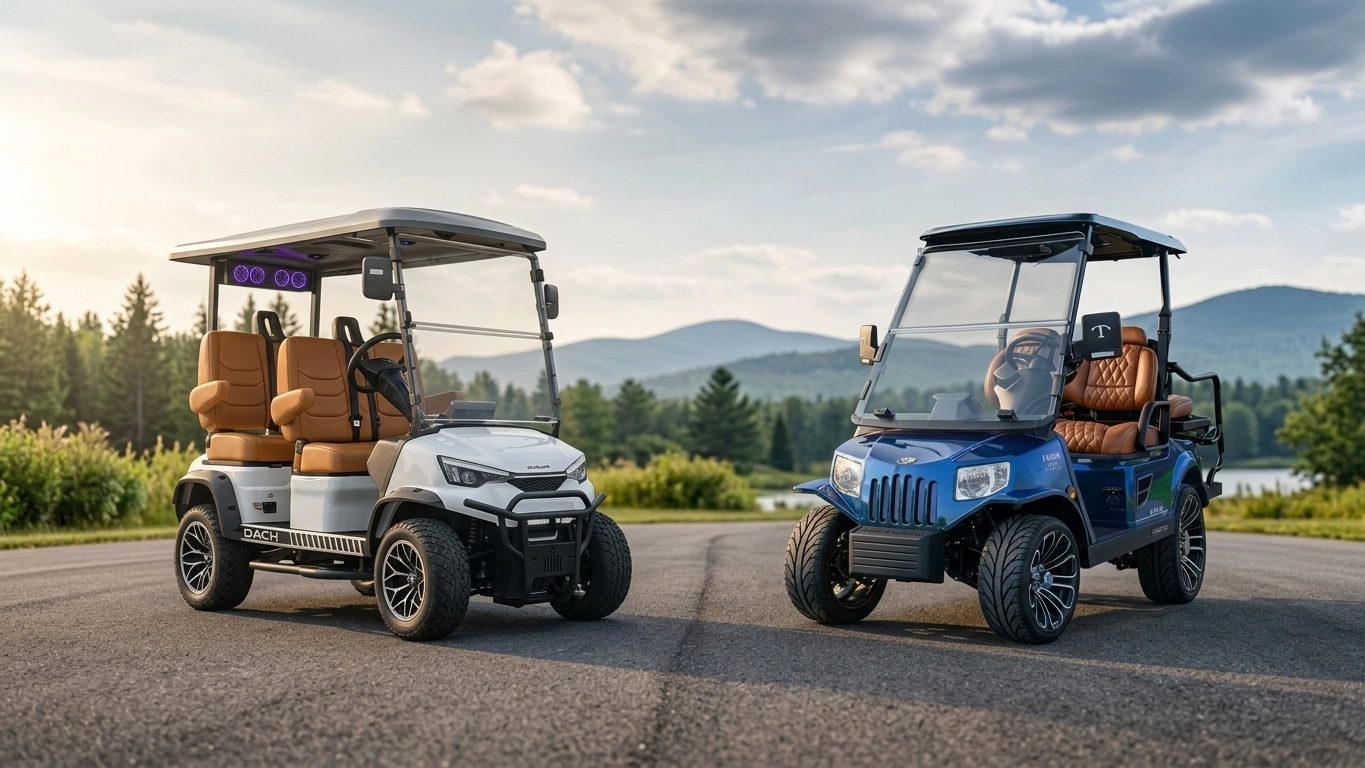
You've been doing your research. You know you want something electric, something that fits your community or property, and something that doesn't require full car insurance and a parking lot.
But somewhere between browsing options online and talking to dealers, you hit a wall: what is the difference between a golf cart and an LSV, and which one actually fits what you need?
If that sounds familiar, you're in good company. This is one of the most common questions buyers across New Hampshire ask before making a purchase, and the answer matters more than most people realize.
Compare golf carts and LSVs and you'll find meaningful differences in legal requirements, safety features, cost, and where you can actually take the vehicle. This guide covers all of it so you can walk into your decision with full clarity.
Why This Question Is Coming Up More Than Ever
The golf cart vs LSV conversation has become more relevant as electric short distance vehicles grow beyond their original niche. The US neighborhood electric vehicle and low speed vehicle market was valued at USD 11.09 billion in 2024 and is projected to reach USD 16.28 billion by 2030. More buyers are entering this space, and many arrive without a clear picture of what each vehicle category actually means.
Industry data highlights strong real world utilization patterns, with 46% of neighborhood electric vehicle owners using their LSV daily for short trips, and 45% frequently traveling distances between two and five miles. These aren't recreational toys for the occasional weekend ride. For a growing number of households and facilities across New Hampshire, they're practical daily transportation.
Electric vehicles now lead the low speed vehicle market with a share of 85.3%, driven by zero emission mobility demand. The shift away from gas is well underway, and most buyers today are choosing between electric golf carts and electric LSVs rather than debating gas versus electric at all.
The Core Difference: What Each Vehicle Actually Is
What a Standard Golf Cart Is
A standard golf cart is designed for use on private property, golf courses, campgrounds, and similar enclosed environments. It typically tops out around 12 to 15 miles per hour, has no federal safety equipment requirements, and is not registered as a motor vehicle. You cannot legally drive a standard golf cart on New Hampshire public roads. Full stop.
This doesn't make it a lesser vehicle for its intended purpose. If you need something for a large property, a resort facility, a farm, or a campground, a standard golf cart is a capable, cost effective, and low maintenance tool. The limitation is simply geographic: it stays off public roads.
What an LSV Is
A Low Speed Vehicle, commonly called an LSV or neighborhood electric vehicle, is a federally recognized motor vehicle category. An electric low speed vehicle is designed to operate on public roads with posted speed limits of 35 miles per hour or lower. It must meet federal safety standards under FMVSS 500 and be registered, insured, and operated by a licensed driver.
The defining speed range is between 20 and 25 miles per hour. Under 20 mph, a vehicle doesn't qualify for the LSV classification. Above 25 mph, it moves into a different vehicle category entirely. That specific window is what makes a street legal golf cart street legal.
For a deeper look at how New Hampshire specifically handles these classifications, the Hampshire Golf Cart Laws 2026 guide covers the state rules in full detail.
Golf Cart Safety Features: What Changes When You Go Street Legal
This is where the two categories diverge most noticeably. A standard golf cart has minimal safety equipment because it operates in controlled environments at low speeds. An LSV is required by federal law to carry a complete set of golf cart safety features built to road use standards.
Here is a direct comparison of what each vehicle type includes:
Feature | Standard Golf Cart | Street Legal LSV |
Headlights | Optional | Required (DOT approved) |
Taillights and brake lights | Optional | Required |
Turn signals | Not required | Required, front and rear |
Windshield | Optional | Required |
Seat belts | Not required | Required at every seat |
Mirrors | Not required | Driver side exterior mirror minimum |
Vehicle Identification Number | Not required | 17 digit VIN required |
Top speed | Typically 12 to 15 mph | Must reach 20 to 25 mph |
Registration | Not required | Required as motor vehicle |
Insurance | Not required | Liability insurance required |
Driver's license | Varies by property | Valid NH license required, minimum age 16 |
These aren't optional upgrades on an LSV. They are compliance requirements. A street legal golf cart that's missing any of these features cannot be registered in New Hampshire and cannot legally operate on public roads regardless of how it looks or how new it is.
If you're unsure whether a specific cart qualifies, the Are Golf Carts Street Legal in New Hampshire guide walks through the registration and compliance process in plain language.
Where Each Vehicle Can Go in New Hampshire
This is often the deciding factor for buyers, and it's straightforward once you understand the classification.
Standard golf carts are permitted on private property, golf courses, campgrounds, and other enclosed environments where the property owner allows their use. Some gated communities and private developments also permit them on internal roads, but this is a property level rule, not a state one. The moment a standard golf cart enters a public road, it's operating illegally.
An electric low speed vehicle registered as an NH Neighborhood Electric Vehicle can travel on any state road with a posted speed limit of 35 mph or lower. It can also cross roads with higher speed limits at intersections, which opens up practical routes across most of southern New Hampshire. For buyers in Londonderry, Manchester, Nashua, and surrounding communities, this means real daily usability.
Cost Comparison: What to Expect at Each Price Point
Price is not always the clearest differentiator between these two categories because both range widely depending on configuration and features. That said, there are general patterns worth understanding.
Standard golf carts typically start lower because they don't require the safety equipment package that an LSV demands. Entry level used options can be found under $5,000. New models with basic configurations often start between $6,000 and $9,000.
LSVs carry a higher baseline cost because of the required safety equipment, compliance engineering, and registration process. Factory built LSV configurations typically start in the $9,000 to $12,000 range for a standard 4 seat model, with 6 seat and premium configurations running higher.
The cost calculation changes significantly when you factor in what you're getting for the additional investment:
- Legal access to public roads across New Hampshire
- Full seat belt protection at every seating position
- DOT approved lighting for safe low light operation
- Turn signals and mirrors that make road sharing practical
For buyers who intend to use the vehicle on public roads, an LSV is not the expensive option. It's the only option that's legal.
Which One Is Right for Your Situation?
The honest answer comes down to where you plan to drive.
If your use case is entirely on private property, a golf course, a campground, a resort facility, or a large estate, a standard golf cart handles that work well and at a lower entry cost. You don't need the compliance package if you're never touching a public road. Golf Carts for private property use are a genuinely practical and cost effective choice for many NH buyers.
If you intend to drive through your neighborhood in Londonderry or Nashua, cross public roads, run errands within a few miles, or use the vehicle as practical daily transportation rather than a property tool, you need an LSV. There is no legal middle ground here. A cart that isn't registered as a neighborhood electric vehicle has no business on a public road regardless of how it's equipped or what the seller implied.
SNH Golf Carts works with buyers across southern New Hampshire to identify the right vehicle category for their specific situation before any purchase decision is made. The starting point is always the same question: where do you actually plan to take it? Shop Golf Carts to see the current LSV and standard cart inventory, or reach out to talk through your specific use case with the team.
Ready to Find the Right Vehicle for Your Needs?
Whether you're looking for a standard cart for your property or a fully registered street legal LSV for daily use across southern New Hampshire, the team in Londonderry is ready to help you figure out exactly which vehicle fits your situation before you spend a dollar.
FAQs: Golf Cart vs LSV in New Hampshire
Q.1 Can I convert my existing golf cart into a street legal LSV? Yes, conversion is possible but involves adding every required safety component, having a VIN assigned if one is not already present, and completing the full NH DMV registration process. The cost and complexity of conversion depend on how far the existing cart is from compliance. For many buyers, purchasing a factory built LSV is more straightforward and reliable than converting an older cart. Premium Golf Carts built to LSV specification are available now if you want to start from full compliance.
Q.2 Is a neighborhood electric vehicle the same thing as an LSV? In New Hampshire, yes. The state uses the term Neighborhood Electric Vehicle, or NEV, in its motor vehicle code, but this refers to the same category as a federally classified Low Speed Vehicle. Both terms describe a four wheeled electric vehicle capable of 20 to 25 mph that meets FMVSS 500 safety standards and is registered for use on public roads with speed limits of 35 mph or lower.
Q.3 Do LSVs require the same insurance as a regular car in NH? Liability insurance is required to register an LSV in New Hampshire, the same as any registered motor vehicle. The cost of insuring an LSV is generally lower than a standard passenger vehicle, but coverage is not optional. Operating an uninsured LSV on a public road carries the same legal consequences as operating any uninsured motor vehicle in the state.
Q.4 What is the minimum age to drive a street legal golf cart in New Hampshire? The minimum age is 16, and a valid New Hampshire driver's license is required. There is no special permit category for LSV operation. Standard licensing rules apply to any operator taking a street legal golf cart onto a public road in the state.