Golf Cart Prices in New Hampshire: New, Used and What to Budget
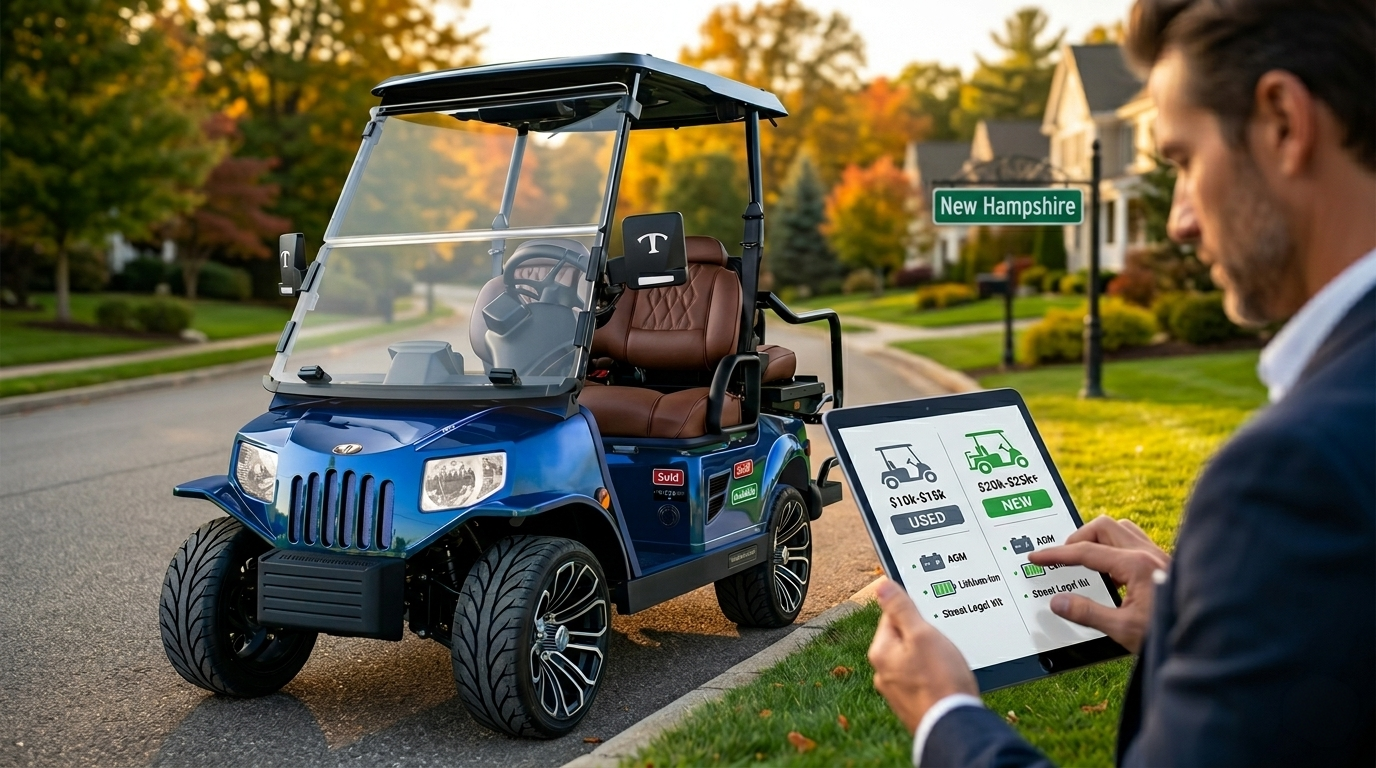
You've been thinking about it for a while. Maybe you've seen them cruising through Londonderry neighborhoods or cutting across quiet Nashua streets, and the idea of owning one has been sitting in the back of your mind. Then you start actually looking at prices and find yourself staring at a range so wide it's hard to know where to begin.
New or used? Electric or gas? Street legal or strictly for private property? The answers to those three questions shape your budget more than almost anything else. This guide walks through golf cart prices in New Hampshire clearly and honestly, so you know what you're working with before you spend a dollar.
The Numbers Worth Knowing First
Before getting into specifics, a few market-level data points help frame the conversation.
New golf cart prices in 2026 range from $5,000 to $23,000 for new models, and from $2,000 to $8,000 for used ones. That's a wide spread, and where you land within it depends heavily on configuration, battery type, and whether the cart is built for road use or private property only.
Annual ownership costs for electric golf carts with lithium batteries tend to be the lowest of any powertrain, running $500 to $800 per year, while gas carts typically run $1,200 to $2,000 annually including fuel, oil changes, and maintenance. Over a five-year ownership period, that difference adds up fast.
And on the electric side specifically: electric golf carts are on track to capture approximately 95% of the market share, driven by their quiet, eco-friendly operation and lower running costs. If you're buying new in New Hampshire today, the question of electric versus gas has largely already answered itself.
New Golf Cart Prices: What to Expect by Category
New golf cart prices vary by seating capacity, battery type, and whether the cart comes factory-configured as a street-legal Neighborhood Electric Vehicle. Here's how the major categories break down for 2026.
Cart Type | Typical Price Range | Notes |
Basic 2-seat electric (lead-acid) | $5,000 to $8,000 | Entry-level, private property use |
Standard 4-seat electric (lead-acid) | $8,000 to $11,000 | Most popular configuration |
4-seat electric (lithium battery) | $10,000 to $14,000 | Lower long-term maintenance costs |
Street-legal LSV / NEV (4-seat) | $9,000 to $16,000 | Factory-compliant, road-ready |
6-seat electric (lithium) | $13,000 to $19,000 | Family or high-use configurations |
Premium/custom builds | $18,000 and up | Luxury finishes, specialty features |
A few things to keep in mind within these ranges. The lithium premium is real upfront, but the math shifts quickly over a full ownership cycle. Lithium batteries last 8 to 10 years, charge in 2 to 4 hours instead of 8 to 12, weigh about 70% less, and need zero maintenance, meaning they often save owners money over the full ownership period despite the higher initial price.
For buyers in southern New Hampshire who plan to use their cart on public roads, the street-legal LSV configurations deserve special attention. A factory-built cart that arrives with a 17-digit VIN already assigned, full safety equipment installed, and documentation ready for the NH DMV registration process is a meaningfully different purchase than a standard cart that would require compliance work after the fact. Are Golf Carts Street Legal in New Hampshire covers the full picture of what qualifies and what doesn't.
Used Golf Cart Prices: Where the Real Value Conversation Gets Interesting
The used market is where a lot of buyers find their entry point, and for good reason. A three to five year old cart often sells for 40% to 60% of its original price, with battery condition being the main driver of the final number.
That depreciation curve is worth understanding before you shop. A cart that was purchased new for $12,000 three years ago might be priced at $5,500 to $7,500 on the used market today, depending on how it was maintained and what's left in the battery pack. For buyers who don't need the absolute latest features, that gap represents genuine savings.
Where the used calculation gets more complicated is batteries. The biggest hidden cost with used electric golf carts is the battery pack. A set of six 8-volt lead-acid batteries costs $800 to $1,200 to replace, while lithium battery upgrades run $2,000 to $4,500 depending on voltage and capacity. If you're buying a used cart with an aging or questionable lead-acid pack, you may be inheriting a battery replacement cost sooner than you expect.
The smart move when evaluating any used cart is to ask for the battery service history and, ideally, have a technician run a diagnostic before you commit. A cart with fresh or recently replaced batteries is worth more than the asking price difference often reflects. A cart with a battery pack on its last legs should be priced accordingly, or skipped.
Used pricing also varies meaningfully by brand. Club Car, E-Z-GO, and Yamaha tend to hold their resale value better than newer or lesser-known names, and parts availability for those brands is broader and more predictable. That matters in New Hampshire, where having reliable local service support is practical, not just a preference.
Electric Golf Cart Prices: Why the Powertrain Choice Matters in NH
In New Hampshire, the electric versus gas question is largely settled by the street-legal requirement alone. Under state law, a Neighborhood Electric Vehicle must be electrically powered. Gas carts do not qualify for NEV registration, period. If there's any chance you want to drive on public roads, you're looking at electric golf cart prices from the start. The Hampshire Golf Cart Laws 2026 guide has the full legal breakdown if you want to go deeper on that.
Beyond the legal angle, the operating cost difference between electric and gas is significant over time. Electric carts have lower fuel and maintenance costs, averaging $100 to $300 per year, while gas models require oil changes, spark plug replacements, and carburetor cleaning, costing $400 to $700 annually.
For private property buyers who aren't concerned with road legality, a used gas cart can occasionally be found at a lower price point than comparable electric options, but the ongoing costs tend to close that gap within a couple of years of regular use.
What Street-Legal Actually Adds to the Price
This is a question that comes up constantly, and the honest answer is: it depends on whether you're buying factory-built or converting.
A factory-built LSV from a reputable brand arrives with everything already included — headlights, taillights, turn signals, windshield, seat belts at every position, mirrors, and a 17-digit VIN. You're paying for compliance engineering that was done before the cart reached the dealership. For most buyers, that's the faster, cleaner, and more reliable path.
Converting an existing standard cart to meet NH's NEV requirements involves sourcing and installing each of those components individually, getting a VIN assigned if one isn't already present, and navigating the DMV registration process with full documentation.
The cost of a conversion varies widely depending on how far from compliance the starting cart is, but it's worth getting a realistic estimate before assuming it will save money over buying factory-compliant.
The practical price premium for a street-legal factory configuration is generally $1,500 to $3,000 over a comparable non-street-legal model. For buyers in Londonderry, Nashua, Manchester, and surrounding communities who plan to use the cart as real transportation rather than just a property vehicle.
That premium unlocks access to any public road with a posted speed limit of 35 mph or lower across New Hampshire. For daily-use buyers, that's not a luxury premium. It's a functional one.
Golf Carts that are built to LSV specification from the factory remove the guesswork from the compliance process entirely.
Hidden Costs Most Buyers Don't Think About
The sticker price is the starting point, not the full picture. Here are the costs that most often surprise first-time buyers after the purchase.
Battery replacement is the big one for electric carts. As covered above, lead-acid packs need replacement every 3 to 6 years at a cost of $800 to $1,500 for a standard replacement, or $2,000 to $4,500 for a lithium upgrade.
Lithium packs last 8 to 12 years and require no ongoing maintenance. That lifespan difference is why many NH buyers are choosing lithium from the start even when the upfront cost is higher.
Insurance is required for any cart registered as an NEV in New Hampshire, the same as any motor vehicle. Annual premiums for street-legal carts typically run $100 to $300, which is considerably less than full passenger vehicle coverage but still a line item worth building into the budget.
Accessories and upgrades add up quickly. Cargo beds, custom seating, upgraded wheels, enclosures for cold weather use, Bluetooth audio systems, and additional lighting are all popular additions. Budget $500 to $2,000 for a typical accessories package depending on what matters most to your use case.
Storage and winterization in New Hampshire is not optional. If the cart will be stored over winter, proper preparation protects the battery and mechanical components from our climate. That may mean a service appointment before storage season, ongoing battery maintenance through the winter, and a spring check before taking the cart back out.
What to Actually Budget: A Realistic Summary
If you're trying to build a practical budget, here's how the numbers come together across the main buyer scenarios.
Private property buyer on a budget: A used 4-seat electric cart in good condition with a healthy battery pack is available in the $4,000 to $7,000 range. Budget an additional $500 to $1,000 for any immediate maintenance needs and basic accessories.
New cart buyer, private property use: A new 4-seat electric cart with lead-acid batteries from a reputable brand runs $8,000 to $11,000. Lithium configurations add $1,500 to $3,000. Plan for $200 to $400 annually in ongoing maintenance and an eventual battery replacement.
Street-legal daily driver: A factory-compliant new LSV runs $9,000 to $16,000 for a standard 4-seat configuration. Add insurance ($100 to $300 per year), registration fees, and the same annual maintenance costs as any electric cart. Shop Golf Carts to see what's currently in inventory across these configurations.
Premium Golf Carts with lithium battery systems and full LSV compliance are available across a range of configurations for buyers who want to start from the best possible position and not think about battery maintenance for a decade.
Ready to Find the Right Cart at the Right Price?
Whether you're shopping for a basic private property cart or a fully street-legal LSV for daily use around southern New Hampshire, the team in Londonderry can help you find the right fit for your budget and your situation before any money changes hands.
Browse Current Inventory at SNH Golf Carts
FAQs: Golf Cart Prices in New Hampshire
Q1. Why do golf cart prices vary so much even within the same category?
The biggest factors are battery type, seating configuration, brand, and whether the cart meets street-legal LSV requirements. Two 4-seat electric carts from different brands, one with lead-acid batteries and one with lithium, can differ by $3,000 or more at the same model tier. The battery chemistry alone explains most of that gap, and the long-term ownership math often justifies the premium for lithium buyers.
Q2. Is it worth buying a used golf cart or should I buy new?
Used carts offer real value, but the key variable is battery health. A well-maintained used cart from a reputable brand with a recent battery replacement can be an excellent purchase. An older cart with a degraded lead-acid pack at a low sticker price may cost you more in the end once you factor in the replacement. Always verify battery age and condition before buying used.
Q3. Do street-legal carts cost significantly more to insure in New Hampshire?
Not significantly more than what you might expect for any registered motor vehicle. Liability insurance for an NEV in New Hampshire typically runs $100 to $300 per year, which is well below what most people pay to insure a standard passenger vehicle. The cost is required for registration, so it's a firm line item rather than an optional one.
Q4. Can I negotiate golf cart prices in New Hampshire the same way I would a car?
Yes, particularly on used inventory and end-of-season purchases. Dealers typically have more flexibility on used carts than on new factory-configured models, and late summer through early fall tends to be a favorable time to negotiate before winterization season. Trade-ins, accessories packages, and service agreements are often more negotiable than the cart price itself.