Golf Cart Care Guide: Best Practices for Maintenance and Performance
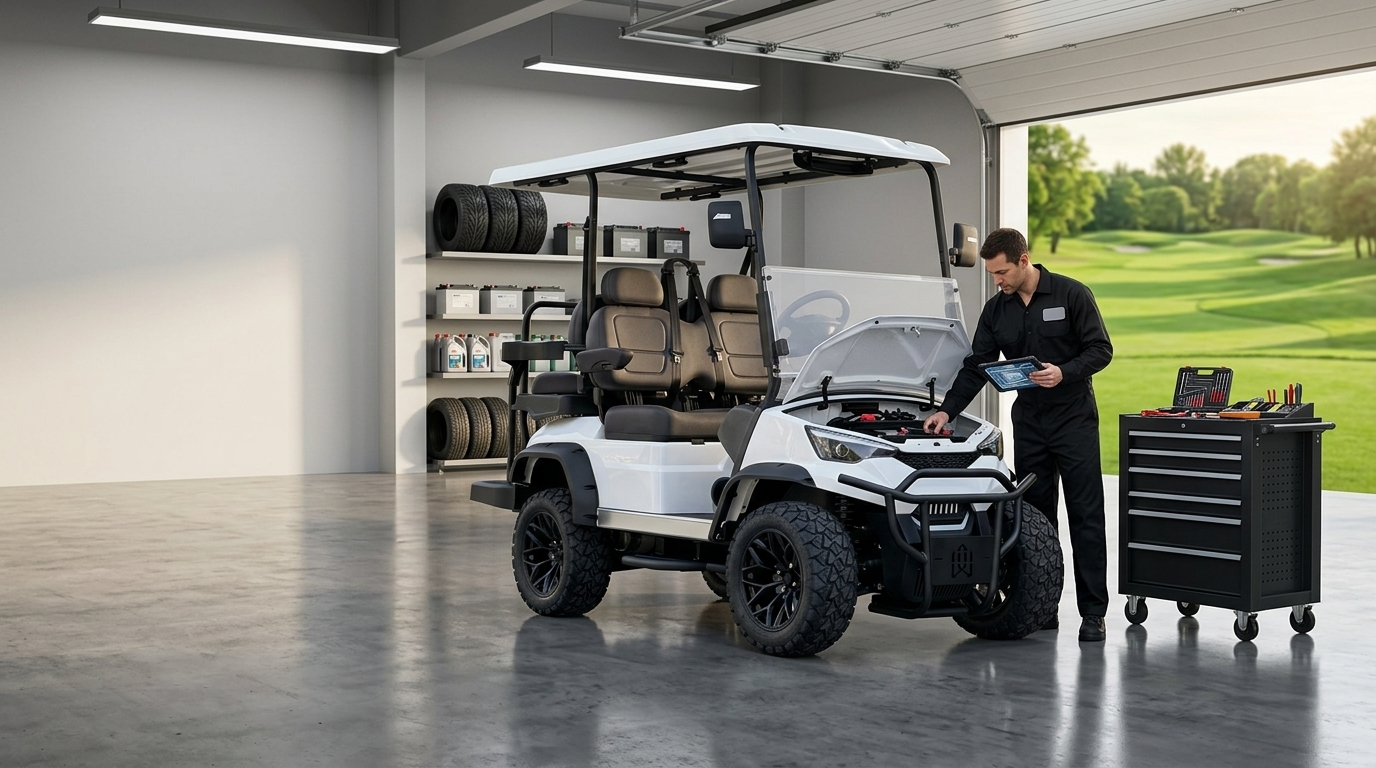
Your golf cart is one of those investments that rewards attention. Treat it well, and it runs reliably for years without drama. Ignore it, and small issues quietly become expensive ones, usually at the worst possible moment, like the morning of a big event or the first warm weekend of the season after a long New Hampshire winter.
This guide covers how to maintain your golf cart the right way: battery care, tires, cleaning, inspections, and the electric golf cart maintenance habits that separate carts that last two decades from those that become headaches in year four. Whether you're a first-time owner or just overdue for a proper refresh on best practices, everything you need is here in one place.
Why Maintenance Matters More Than Most Owners Realize
Golf cart maintenance isn't just about keeping the cart looking clean. It has a direct and measurable impact on lifespan, performance, and the cost of ownership over time.
A well-maintained golf cart can last 20 to 30 years, with electric models depending heavily on battery care and gas carts relying on consistent engine servicing. That lifespan potential is real, but it doesn't happen by accident.
A systematic battery care protocol at a renowned resort saved the facility over $50,000 annually in replacement and labor costs. The math scales down for individual owners, but the principle holds: consistent care is the single most effective thing you can do to delay the costs that eventually find every cart.
DIY maintenance saves $150 to $300 annually versus full professional service, and most of the routine work covered in this guide requires nothing more than 30 minutes, basic tools, and a little consistency. That's a straightforward return on a small time investment.
Battery Care: The Foundation of Everything Else
For electric golf cart maintenance, the battery is the place to start and the place to spend the most attention. It's the most expensive single component in the cart, the most sensitive to neglect, and the one that most directly determines how well the cart performs on any given ride.
How you care for the battery depends on which chemistry you're running, and the routines are genuinely different for lead-acid versus lithium.
Battery Type | Charge Habit | Storage Level | Maintenance Needed | Cold Weather Risk |
Flooded Lead-Acid | Charge after every use | Fully charged (100%) | Monthly watering and terminal cleaning | High: can freeze if discharged |
AGM (Sealed Lead-Acid) | Charge after every use | Fully charged (100%) | Minimal, no watering | Moderate |
Lithium (LiFePO4) | Charge as needed | 50 to 70% for storage | None: fully sealed | Low: handles cold well |
For lead-acid batteries, the most important rule is to never let the pack sit discharged, especially in winter. A fully charged lead-acid battery has a freezing point around negative 80°F, while a discharged one can freeze at just 20°F, well within a typical New Hampshire January night. Checking water levels monthly, cleaning terminals with a baking soda and water solution, and applying petroleum jelly to prevent corrosion are all non-negotiable parts of lead-acid care.
For lithium batteries, the routine is dramatically simpler. There's no watering, no equalization charging, and no monthly check-in requirement. The key habits are using the correct compatible charger, avoiding complete discharge, and storing the pack at a partial charge rather than full when the cart will be unused for an extended period. Lithium batteries should not be charged below 32°F, so if the cart is stored in an unheated garage through a New Hampshire winter, bring the pack inside or wait until temperatures rise before plugging in.
If your cart is showing signs of reduced range, sluggish acceleration, or longer charging times, the electric golf cart battery replacement guide covers exactly how to read those warning signs and when it's time to act.
Tires: The Part Everyone Forgets Until It's a Problem
Tires affect ride quality, handling, battery efficiency, and safety, and they're one of the most overlooked areas of golf cart maintenance. A cart running on underinflated tires works harder than it needs to, drains the battery faster, and puts uneven wear on the treads in a way that shortens their useful life.
Check tire pressure at least monthly during active use and before bringing the cart out of storage. Most golf cart tires run best between 15 and 25 PSI; the exact spec is on the sidewall or in your owner's manual. Inflate to the correct level and inspect each tire for visible wear, cracking, or embedded debris while you're at it.
Before winter storage, inflate tires to their recommended PSI and place wheel chocks against the tires rather than relying on the parking brake. A stationary cart parked on the same spot for months develops flat spots from sustained weight on one area of the tire, and those flat spots affect ride quality when you pull the cart out in spring.
Cleaning and Exterior Care
A clean cart isn't just about appearances. Dirt and road grime left on the frame, undercarriage, and battery compartment hold moisture against metal surfaces and accelerate corrosion over time. Regular washing is genuinely a maintenance task, not just cosmetic upkeep.
Wash the cart with soap and water, paying attention to the undercarriage and the area around the battery compartment. A degreaser handles stubborn grime buildup in wheel wells and under the frame. After washing, dry the cart thoroughly before storage or covering, since trapping moisture accelerates the exact damage you're trying to prevent.
Apply a coat of car wax to painted surfaces at least once a season to protect the finish from moisture, UV exposure, and oxidation. For any chrome or metal trim, a light coat of protective oil prevents surface rust from establishing a foothold, particularly through the wet shoulder seasons that New Hampshire delivers reliably every spring and fall.
Brakes, Steering, and Mechanical Inspection
Golf cart service isn't complete without a regular look at the mechanical systems that actually keep the cart safe to operate. These systems don't need constant attention, but they do need periodic checks.
Test brakes at the start of each season and any time braking feels different from usual. Soft, spongy, or weak braking is a signal to have the system inspected rather than something to wait on. Check cable tension on both the parking brake and the primary brake system. Cables that have stretched or seized through winter storage need to be addressed before the cart goes back into regular use.
Inspect the steering for any unusual play or stiffness. A small amount of movement is normal; significant looseness or grinding when turning is not. Check all bolts and fasteners on the frame, seat mounts, and suspension components, since vibration from regular use gradually loosens hardware that was tight at the factory.
For carts registered as street-legal Neighborhood Electric Vehicles, this mechanical inspection isn't optional. All safety equipment, including lights, turn signals, mirrors, and seat belts, needs to be functional before the cart operates on a public road. Regular checks keep the cart in compliance and keep you and your passengers safe.
The Golf Cart Maintenance Checklist: Organized by Frequency
Consistent golf cart maintenance is easier to stick with when it's broken into manageable intervals rather than treated as one overwhelming annual project. Here's how the tasks break down across daily, monthly, seasonal, and annual timeframes.
Daily and Pre-Ride
- Check battery charge level before heading out; avoid running below 20% to 30% on lead-acid systems
- Inspect tires visually for obvious low pressure or damage
- Test brakes and confirm all lights are functional on street-legal carts
Monthly During Active Use
For lead-acid batteries: check water levels in each cell and top off with distilled water as needed. Inspect terminals for corrosion and clean if necessary. Check tire pressure and inflate to spec. Review brake feel and steering response.
Seasonal (Spring and Fall)
Spring brings the cart out of storage. Before the first ride, reconnect the battery, check charge level, inspect all tires, test brakes and lights, and verify all safety equipment on street-legal configurations. Check for any pest damage to wiring if the cart was stored in a garage.
Fall means winterization. Clean the cart thoroughly, bring lead-acid batteries to full charge and then disconnect the negative cable, set tires to recommended PSI, place the Tow/Run switch to TOW if equipped, and cover with a breathable weatherproof cover.
Annual Professional Service
Even with consistent DIY care, a professional annual service appointment catches what everyday inspections miss. Brake adjustment, controller diagnostics, motor inspection, suspension checks, and charger testing are all tasks that benefit from proper equipment and trained eyes. Repair and Maintenance appointments at a proper golf cart service facility add genuine value beyond what a home routine alone covers.
When Maintenance Opens the Door to Upgrades
Routine service appointments are also a natural moment to think about what the cart could do better. If range has been a persistent frustration, a lithium battery upgrade changes the ownership experience more than almost any other single improvement. If the cart sees rough terrain, suspension upgrades and upgraded tires make a meaningful difference in comfort and handling. If it's used as a street-legal daily driver, lighting upgrades, enclosures, and additional safety features all add practicality to a cart that's already doing real work.
Upgrades and modifications are worth exploring alongside a service visit rather than as a separate afterthought. Doing both at the same time typically reduces labor costs and ensures any new components are properly integrated with the cart's existing systems.
Golf Carts that are well-maintained and thoughtfully upgraded hold their value better, perform more reliably, and stay enjoyable to own for far longer than carts that receive neither.
Keep Your Cart Running at Its Best
Consistent care adds years of reliable performance and saves real money on repairs and replacements. Whether you handle routine maintenance yourself or prefer to bring the cart in for professional service, staying ahead of the schedule is always cheaper than catching up after something breaks.
Book a Service Appointment at SNH Golf Carts
FAQs
Q1. How often should I service my electric golf cart?
A professional golf cart service appointment once a year is the standard recommendation for electric carts in regular use, with more frequent visits if the cart is used daily or in demanding conditions like steep terrain or year-round NH weather.
Q2. What is the most important part of electric golf cart maintenance?
Battery care is the single most impactful maintenance habit for electric golf carts. The battery pack is the most expensive component in the cart, the most sensitive to neglect, and the most directly connected to daily performance.
Q3. Can I do golf cart maintenance myself or do I need a professional?
Most routine maintenance, including battery checks, tire inflation, terminal cleaning, washing, and visual inspections, is straightforward DIY work that requires basic tools and about 30 minutes per session. More complex tasks like brake adjustment, controller diagnostics, motor inspection, and electrical repairs benefit from professional service.
Q4. How do I know when my golf cart needs professional service rather than a routine maintenance check?
Specific warning signs point toward a service appointment rather than a routine home check: reduced range that doesn't recover after a full charge, unusual noises such as grinding or clicking during acceleration. Or braking, spongy or delayed brake response, visible corrosion on battery terminals that's deeper than surface level, and any burning smell during operation or charging.