Where Can You Drive a Golf Cart in Southern NH?
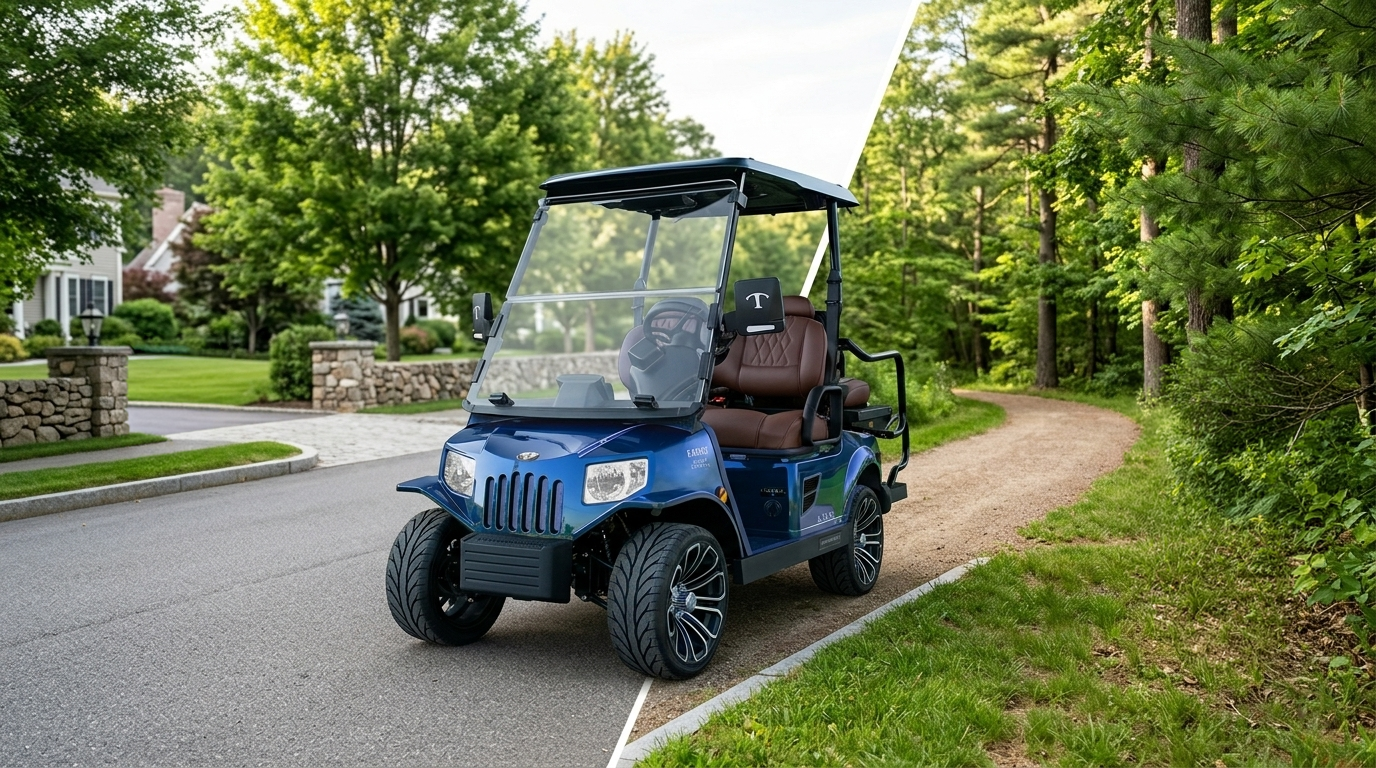
A golf cart can make getting around Southern New Hampshire feel simple, relaxed, and wonderfully local. Whether you are heading from home to a nearby gathering, exploring a private property, or looking for a permitted trail, the freedom of a golf cart comes with one important question: where can you actually drive it?
New Hampshire golf cart laws depend heavily on how the vehicle is classified, where you plan to operate it, and whether the road or trail is specifically open to that type of vehicle. A neighborhood electric vehicle can have a maximum speed of more than 20 miles per hour and no more than 25 miles per hour, and New Hampshire limits its operation to ways with a posted speed limit of 35 miles per hour or less. For OHRVs, the state also sets specific speed rules, including 20 miles per hour on approved roads and 35 miles per hour on approved OHRV trails unless another limit is posted. Southern New Hampshire also has an 18 mile section of the Rockingham Recreational Rail Trail where summer OHRV use is permitted between Route 28 in Derry and Route 107 in Fremont.
That distinction matters because a golf cart is not automatically a street legal vehicle simply because it has lights, mirrors, or seat belts. Before you turn the key and head down a Southern NH road, it helps to understand the difference between a standard golf cart, an OHRV, and a neighborhood electric vehicle.
What Makes a Golf Cart Street Legal in New Hampshire?
The first step is understanding classification. New Hampshire law recognizes several types of vehicles, and the rules for each are different. A traditional golf cart is designed primarily for private property, golf courses, communities, events, and similar settings. Adding accessories to a standard cart does not automatically give it permission to travel on every public road.
A neighborhood electric vehicle, often called an NEV, is a specific legal classification. New Hampshire defines an NEV as a four wheeled electric vehicle with a maximum speed greater than 20 miles per hour but no greater than 25 miles per hour that complies with federal safety standards. Those federal standards involve equipment such as lighting, braking, mirrors, seat belts, windshield equipment, and other safety features.
The road restriction is equally important. Under RSA 265:158, a neighborhood electric vehicle may operate only on a way where the posted speed limit is 35 miles per hour or less. It can cross an intersection with a higher posted speed limit, but that does not mean it can travel along the higher speed road.
This is why choosing the right vehicle matters before planning your route.
Golf Cart, OHRV, or NEV?
Vehicle type | Where it may be used? | Important consideration |
Traditional golf cart | Private parties or at the permitted locations | Not automatically legal on the public roads |
OHRV | Approved ways, trials and other locations (allowed by law) | Registrations requirements |
Neighbourhood electric vehicle | Public ways with speed of 35 miles per hour | Federal safety requirements |
Street legal golf cart configuration | Depends on the legal classification | Registration and local rules |
The safest approach is to identify the legal classification of the specific cart rather than relying on the phrase “street legal.”
Where Can You Drive a Golf Cart in Southern NH?
Southern New Hampshire offers a mixture of residential roads, private communities, recreational trails, town roads, and private land. The rules can change from one location to another, so there is no single list of every road where you can drive a golf cart.
Instead, think about the type of location you want to visit.
Private Property
Private property is often the simplest place to enjoy a golf cart.
If you own the property, you generally have much more flexibility in how you use your cart, subject to applicable safety requirements and local restrictions. Large residential properties, farms, campgrounds, private communities, event properties, and commercial properties may all offer opportunities for golf cart use.
If the property belongs to someone else, permission matters. New Hampshire OHRV law specifically addresses operation on land belonging to another person, and written permission can be required.
That makes a simple rule worth remembering, never assume that an open looking trail or field means you have permission to ride there.
Approved OHRV Trails
Southern NH also has legitimate places for recreational riding.
One notable example is the Rockingham Recreational Rail Trail. New Hampshire State Parks identifies the trail as an 18 mile multi use trail running between Windham and Epping, with summer OHRV use permitted from Route 28 in Derry to Route 107 in Fremont.
This is a useful example of why checking the exact section of a trail matters. Not every portion of a recreational trail has identical access rules. The state also maintains information about recreational rail trails and OHRV access, making the New Hampshire State Parks website a helpful resource before planning a ride.
Certain Town Roads
New Hampshire gives municipalities authority over OHRV operation on certain roads.
Under RSA 215 A:6, cities and towns may authorize OHRV use on sidewalks and portions of Class IV, Class V, and Class VI highways and bridges following the required local process. When OHRVs are allowed on these roads, operators must keep to the extreme right and yield to conventional motor vehicle traffic.
This is where local rules become important in Southern NH.
A road that looks perfect for a slow golf cart ride may still be closed to OHRV use. A nearby road in another municipality may have a different rule. Local signs and municipal ordinances therefore deserve the same attention as state law.
What About Class VI Roads?
Class VI roads can create confusion because they often look more like trails than conventional roads.
New Hampshire defines Class VI highways as existing public ways that are not maintained in the same manner as regular town roads. These roads can be subject to gates and bars, and municipalities retain regulatory authority over their use.
For OHRV riders, some Class VI roads may be available when properly authorized. Others may not be.
The important point is that Class VI status by itself does not mean every golf cart can travel there. The vehicle must qualify for the applicable rules, and the particular road must allow the type of operation you intend to conduct.
Can You Drive a Golf Cart on a 35 Mile Per Hour Road?
This question comes up often, and the answer depends on the vehicle classification.
For a neighborhood electric vehicle, New Hampshire law permits operation on a way with a posted speed limit of 35 miles per hour or less. A road with a 35 mile per hour limit can therefore fall within the legal operating range for a properly equipped NEV. That does not mean every golf cart can use that road. The cart needs to meet the requirements of its legal classification, and the road itself must not have another restriction. A conventional golf cart cannot simply become an NEV because the road has a 35 mile per hour speed limit. For OHRVs, the rules are different. New Hampshire establishes a 20 mile per hour limit for OHRVs on approved Class IV, Class V, and Class VI highways and certain adjacent rights of way, while approved OHRV trails generally carry a 35 mile per hour limit unless posted otherwise. Reading the route correctly is just as important as reading the cart.
Do You Need to Register a Golf Cart in New Hampshire?
Registration depends on the vehicle classification and how you plan to use it.
OHRVs generally require registration when operated under New Hampshire OHRV law. The current individual resident registration fee for an OHRV other than a two wheeled trail bike is $81 without qualifying club membership, or $51 with proof of membership in an eligible New Hampshire nonprofit OHRV club.
The registration certificate must be carried while the OHRV is being operated, and the vehicle must display the required registration decal. A neighborhood electric vehicle follows a different path because it falls under New Hampshire motor vehicle requirements rather than simply being treated as an OHRV. This is one reason it is worth confirming your cart's classification before purchasing accessories or planning regular road use.
If you are comparing options, you can explore Golf Carts Golf Carts and look for a vehicle that fits the way you actually intend to ride.
What Equipment Does a Road Legal Cart Need?
A vehicle intended for public road use needs the appropriate safety equipment for its classification.
For NEVs, New Hampshire's requirements connect to federal safety standards under 49 CFR 571.500. The state legislation identifies equipment including headlamps, stop lamps, turn signals, tail lamps, reflectors, parking brake, mirrors, windshield, windshield wiper, speedometer, odometer, braking equipment, seat belts, and a vehicle identification number. The details matter because a cart that looks complete may still lack equipment required for its classification.
Before driving on a public way, check the vehicle identification, lights, mirrors, brakes, tires, seat belts, windshield equipment, and registration requirements. If something does not match the applicable standard, keep the cart on private property until the issue is resolved.
Why Local Rules Matter in Southern NH
New Hampshire law establishes the foundation, but municipalities can add rules governing OHRV operation within their boundaries. RSA 215 A:15 allows city and town councils and boards of selectmen to regulate OHRV operation through local bylaws or ordinances, provided those rules do not conflict with state law.
This means your route can cross an invisible legal boundary even when the pavement, trail, or neighborhood looks exactly the same. Windham provides a useful example of why checking local information matters. The town publishes notices explaining that OHRVs are prohibited in the McIlvaine Town Forest and that the town has additional local restrictions on OHRV use.
For Southern NH riders, it is smart to check the town website, police department, town clerk, or parks department before using an unfamiliar route.
Before You Take the Cart Out
A quick check can prevent an enjoyable afternoon from turning into an unexpected problem.
- Confirm your vehicle classification and registration status.
- Check the town rules for your route.
- Look for posted signs and trail restrictions.
- Carry any required registration documents.
- Confirm that lights, brakes, mirrors, tires, and seat belts work properly.
- Make sure you have permission before operating on private property that belongs to someone else.
These small habits create a more relaxed ride because you know the route and the rules before you leave home.
Choosing the Right Golf Cart for Southern NH
The best golf cart is not necessarily the fastest or most heavily equipped model. It is the cart that fits the places you actually want to use it.
If your plans center around private property, a traditional golf cart may provide everything you need. If you want recreational trail access, an OHRV classification may be more relevant. If your goal is neighborhood transportation on public roads, a properly equipped NEV may make more sense.
That is where thoughtful selection becomes valuable.
SNH Golf Carts helps Southern New Hampshire drivers explore different golf cart options, including electric models and vehicles designed for practical everyday use. You can also browse Shop Golf Carts Shop Golf Carts to compare available options.
If you are unsure which direction makes sense, start with how you plan to use the vehicle. Think about your neighborhood, your property, your typical distances, the roads near your home, and whether trails are part of the experience.
A cherished golf cart becomes part of everyday life when it fits naturally into the places you already enjoy.
A Few Helpful Southern NH Resources
New Hampshire provides several useful official resources for checking rules before you ride.
The New Hampshire General Court publishes the current state statutes covering neighborhood electric vehicles and OHRVs, including the rules that determine where certain vehicles can operate on public ways.
New Hampshire State Parks provides information about recreational rail trails, including permitted OHRV sections, seasonal access, and trail use requirements. Its current trail information identifies the Rockingham Recreational Rail Trail, Fremont Branch as an 18 mile multi use trail, with summer OHRV use permitted from Route 28 in Derry to Route 107 in Fremont.
For registration and trail regulations, riders can also consult the New Hampshire Fish and Game Department OHRV information and the state's official OHRV guidance. New Hampshire State Parks notes that wheeled OHRVs must be registered when they are operated off the owner's property, making registration an important step before using designated public trails.
For a broader look at ownership costs, read Golf Cart Prices in New Hampshire Golf Cart Prices in New Hampshire. If you keep your cart through the colder months, How to Winterize Your Golf Cart in New Hampshire How to Winterize Your Golf Cart in New Hampshire offers practical seasonal guidance.
You can also learn more about the benefits of road ready vehicles in Why Golf Carts and Street Legal Carts Are a Game Changer Why Golf Carts and Street Legal Carts Are a Game Changer.
The Bottom Line
So, where can you drive a golf cart in Southern NH?
The answer depends on what your golf cart legally is and where you want to take it. Private property is generally the simplest setting. Approved OHRV trails provide recreational opportunities for properly registered and equipped vehicles. Certain town roads may permit OHRV use when local authorization is in place. Properly classified neighborhood electric vehicles can operate on public roads with posted speed limits of 35 miles per hour or less when they meet the applicable safety requirements.
The most important step is to check before you ride. New Hampshire has clear statewide rules, while Southern NH municipalities can add their own requirements.
At SNH Golf Carts, the goal is simple: help you find a golf cart that fits your lifestyle, your property, and the roads and recreational spaces you want to enjoy. With the right vehicle and a little preparation, driving through Southern New Hampshire can feel easy, comfortable, and genuinely enjoyable.
FAQs
Can I drive a regular golf cart on public roads in Southern NH?
Not automatically. Public road use depends on the vehicle's legal classification, required equipment, registration, posted speed limit, and any applicable local rules.
Can I drive a golf cart on the Rockingham Recreational Rail Trail?
Only an appropriately classified and registered vehicle may use the permitted OHRV section, and seasonal and location restrictions apply. Summer OHRV use is permitted from Route 28 in Derry to Route 107 in Fremont.
Does every Southern NH town have the same golf cart rules?
No. New Hampshire allows municipalities to regulate OHRV operation through local ordinances and bylaws, so rules can vary between towns.
Is a neighborhood electric vehicle the same as a regular golf cart?
No. An NEV is a specific legal vehicle classification with defined speed and federal safety requirements, and New Hampshire restricts its operation to ways with posted speed limits of 35 miles per hour or less.